JEI Voices Hope as Israel and Hamas Move Forward with Peace Framework
October 9, 2025
JEI Voices Hope as Israel and Hamas Move Forward with Peace Framework
Washington, DC — “We are watching with great hope and cautious optimism as Israel and Hamas move forward with an agreement that envisions the return of all Gaza hostages and lays the groundwork for a new chapter in the region.
“This moment could mark the beginning of the end, a turning point toward a more stable and secure future for Israelis and Palestinians alike. We anxiously await the results of this agreement with hope that it brings relief to families, accountability for violence, and a path toward lasting peace.”

To: Jewish Electorate Institute From: The Mellman Group Re: Survey Shows Most U.S. Jews Are Not Following Pro-Israel Spending In ’26 Primaries And Are Divided On Its Value Date: April 6, 2026
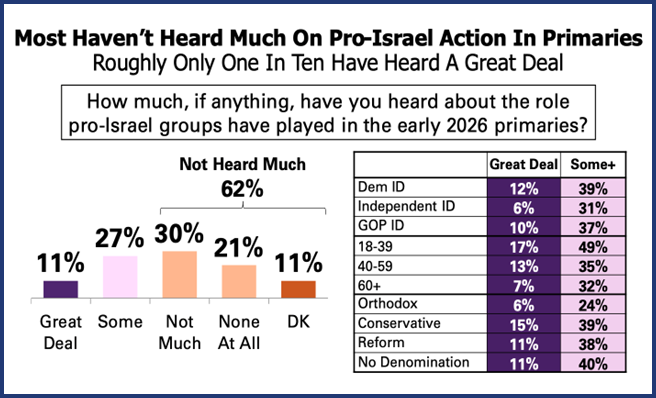
FOR IMMEDIATE RELEASE MEDIA CONTACT: info@jewishelectorateinstitute.org TUESDAY, APRIL 7, 2026 202-695-0531 U.S. JEWS IDENTIFY AS BOTH PRO-ISRAEL & CRITICAL OF ITS GOV’T Jewish Repub’s, Indi’s Support Pro-Israel Spending in Primaries; Dems Less So AIPAC popular among R’s, not as much among D’s; DMFI better liked by D’s WASHINGTON – As the Democratic National Committee sets to convene in New Orleans this week and consider resolutions on Israel and its AIPAC lobby, a new poll for the Jewish Electorate Institute (JEI) finds the majority of American Jews identifies as both pro-Israel and critical of the Israeli Government. There is limited awareness of the spending by pro-Israel groups in the 2026 primaries, with only one in ten saying they have heard a great deal about it. Attitudes split on partisan lines with majorities of independent and Republican Jews supporting this spending, while a plurality of Democrats is opposed. But still, the majority of Democrats are either not sure or supportive, the poll finds. These are among the top findings of a survey of registered Jews nationally for the JEI by The Mellman Group, several others of which were released last week before Passover. A fuller release of all its findings will come on Friday, after the holiday ends. Further, attitudes about AIPAC and DMFI, the pro-Israel groups spending the most in these primaries, are also split on partisan lines, with AIPAC slightly underwater among Democrats, and popular among Republicans. DMFI is less known but better liked among Democrats. J Street’s numbers are relatively even but measurably smaller. This analysis is based on the findings of a survey of 800 registered Jewish voters nationally. The survey was conducted for JEI by The Mellman Group using a high-quality online national panel from March 13-23, 2026. The margin of error for the sample as a whole is +/-3.5% at the 95% level of confidence (higher for subgroups). Majority of U.S. Jews Identifies as Both Pro-Israel and Critical of Israeli Policies An overwhelming 86% of American Jews describe themselves as generally pro-Israel. However, fewer than one-quarter (23%) say they are both pro-Israel and supportive of Israeli policies. A 63% majority identifies as pro-Israel and critical of the Israeli government policies – split roughly equally between those who are critical of some policies (32%) and those critical of many (31%). Just a combined 14% say they are not generally pro-Israel (9%) or do not hold a view (5%). This trend is not dissimilar to one in the JEI poll that shows Jews are also generally patriotic towards America but also critical of some government policies, numbers for which will be released Friday. While pro-Israel sentiment extends across party (84% of Democrats, 90% of independents, 94% of Republicans), Democrats are considerably more likely to be critical of Israeli policies (73% critical) than independents (44%) and Republicans (39%).
A majority of Jewish Americans disapprove of President Donald Trump’s decision to wage war against Iran, according to a new national survey released Monday by the Jewish Electorate Institute (JEI). The poll, conducted in mid‑March among 800 registered Jewish voters, found that 55 percent disapprove of U.S. military action against Iran, while 32 percent approve, and the remainder say they are undecided or conflicted.